
For parents and educators
What an AI-native game is, and how it differs from a game with AI features
What makes a game AI-native? Explore how player ideas change Vibo worlds, with real examples, family creativity, prototype capabilities and limits.
For parents and educators
For parents and educators choosing a creative environment and evaluating the role of AI. This overview uses technical concepts and describes a prototype. With a child, discuss a specific idea and its playable result rather than expecting independent reading of the full article.
An AI-native game is a game in which artificial intelligence is part of the core play loop: a player’s idea becomes a real, persistent change to the world, and play continues after that change. AI is not limited to a character line, a hint, or a striking image.
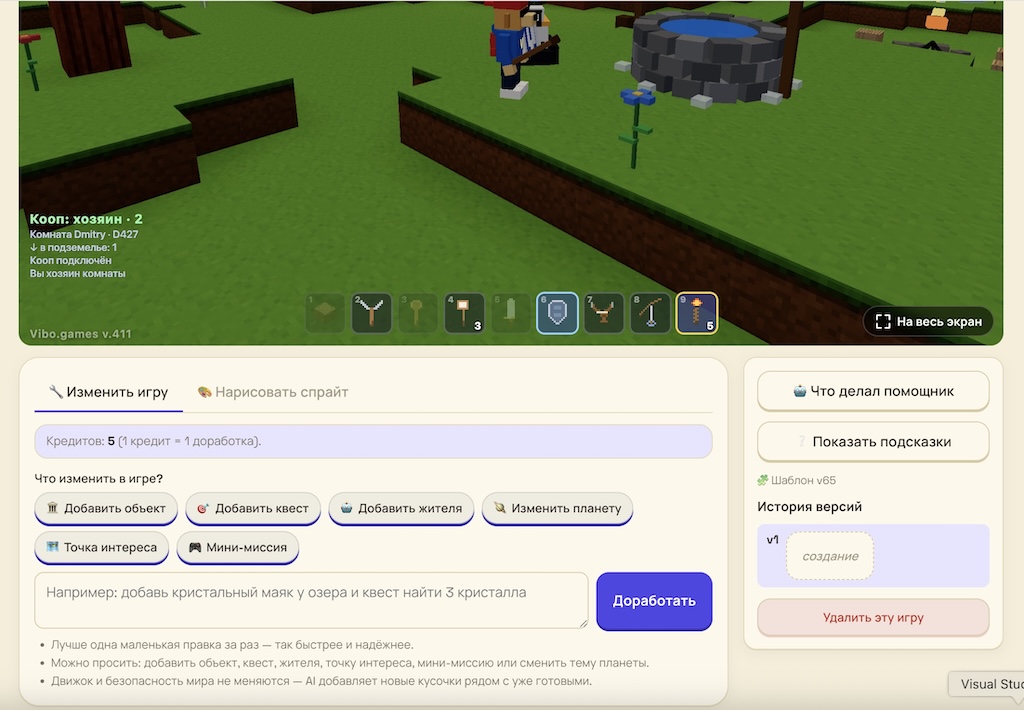
Vibo is being built both as this kind of game and as the browser technology behind it. A player describes an idea through text or voice, sees the change inside a 3D voxel world, explores the result, keeps editing it, saves a personal copy, and can publish that version.
A game with AI features is not necessarily AI-native
AI already helps studios draft code, create concept art, voice characters, and propose dialogue variations. These are useful production tools. But if players still receive a fully prebuilt world and AI exists only in a separate chat, the game architecture itself has not become AI-native.
| Approach | Role of AI | What the player receives |
|---|---|---|
| Conventional game | AI is absent or used only during production | A prebuilt world and predefined actions |
| Game with AI features | AI powers a chat, an individual NPC, or a media generator | A line, hint, image, or sound |
| AI-native game | AI participates in changing game state | A new object, part of the world, condition, or story that remains interactive |
The difference becomes clear after generation. If the result can only be viewed as a frame, it is media. If players can walk up to it, move around it, use it in a quest, save it, and change it again, it has become part of the game.
A working definition for Vibo
Vibo is an AI-native browser game for children and parents to create interactive worlds together. Vibo Engine is its game engine, turning natural-language requests into controlled changes to those worlds.
The product aims to shorten the distance between “I imagined it” and “we are already playing it.” A user should not have to master a professional editor, object coordinates, or a programming language first. At the same time, Vibo does not promise unrestricted generation of any possible game from one sentence: every change must fit the capabilities of the current world and leave it playable.
The observable journey from a request to a game object is explained in How text and voice become an editable voxel world.
Five signs of an AI-native game
1. Natural language is part of the game interface
Players describe the result they want in ordinary language without leaving the game. Vibo supports text input, while push-to-talk voice commands already work in the author build. Voice matters in a family product because a child can say an idea more easily than type a precise command.
2. AI changes the real world, not just its image
An AI image of a castle may look convincing, but it has no game geometry, state, or behavior. In Vibo, the result appears inside a running scene. A character can interact with it and the camera can inspect it from different angles.
This is why the Vibo Engine page separately presents real prototype captures. Atmospheric illustrations communicate the project’s mood; screenshots substantiate the product that exists.
3. The world keeps its rules and remains playable
Freedom is useful only while a new idea does not break controls, quests, or the existing environment. Vibo applies changes through supported engine capabilities and automatically checks safety, compatibility, and playability. The internal formats and rules behind this process are not part of the public documentation.
4. The result can be continued
An AI-native loop does not end with the first successful request. A player can add another object, change the story, continue a quest, or return to the world later. This turns AI from a one-off generator into a co-author of play.
5. The world can be shared
Personal voxel-world instances, cloud saves, and publication of a built starting map are already implemented for early access. A creator can use an existing adventure as a base, develop a personal version, and submit it for moderated publication. Room-code co-op lets people explore together.
Discussing AI games with a child
During a shared creative activity, a child can imagine an object’s purpose and explain why the game world needs it. An adult helps phrase the request, then they compare the playable result with the original idea: what fits, what should change, and how to check the next version. This gives the child a role in describing, evaluating and revising an idea.
Choose a concrete example rather than asking a child to understand the full technical overview. The prototype capabilities and availability described below remain dated, and an adult should check access before planning an activity.
What works in the current version
This status is current as of July 16, 2026. Some capabilities remain in early access and should not be interpreted as a fully open public service.
- launch of a 3D voxel world in a modern browser;
- a ready-made game story with quests and NPCs;
- text-driven world changes;
- push-to-talk voice commands in the author build;
- creation and cloud saving of a personal voxel world in early access;
- publication of a built starting map through moderation;
- a room-code co-op session;
- automated checks before a change appears in the game;
- real captures of the editor, quests, and shared scene.
Honest limits
AI-native does not mean “AI can do everything.” In the current version:
- one sentence does not create any game genre without constraints;
- arbitrary new physics, complex animation, or a mechanic unknown to the engine still requires engine development;
- the voxel world is finite and is not presented as an infinite procedural map;
- the game supports a defined set of objects, actions, and change types;
- public voice input still requires the production server-side speech path;
- broader access to personal voxel worlds and publishing is not open yet;
- concept art is never presented as proof of a working game feature.
These limits build trust. An investor, journalist, parent, or search system benefits more from a dated, verifiable claim than from a sweeping promise without a working example.
The most useful category for Vibo
“Metaverse” is too broad: it does not explain what a user does in the product. “Open world” describes spatial structure, but not the engine’s central difference. The clearest primary description is:
An AI-native world-building game for kids and families
For a technical audience, it can be expanded to:
A browser-based AI-native game engine for creating and changing interactive voxel worlds through natural language
This positioning connects Vibo to meaningful search topics — AI games, world-building games, generative game worlds, and browser game engines — without promising capabilities the product does not yet have.
Why the browser strengthens this model
A browser shortens the path from a link to play. There is no separate editor to install, and a second participant can join the adventure from another device. The same interface lets someone play first, change the world next, and gradually become its author.
The strongest evidence for an AI-native approach is neither a promotional video nor a detailed account of the internal architecture. It is a live experience: a user asks for a change and immediately tries the result in the game. That is why Vibo’s next public proof point is an open browser demo.
See the current capabilities and real captures on the Vibo Engine page.